
AAC Plant Setup
Set up a reliable, efficient and future-ready AAC block manufacturing plant with the right process design, machinery planning, layout engineering and commissioning support from Amazin TechnoChem.
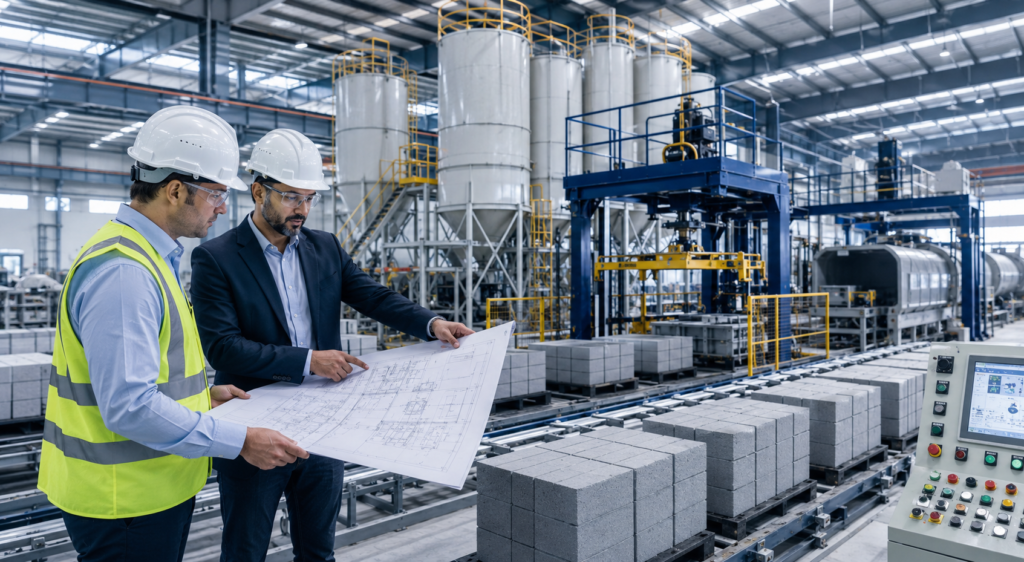
What Is an AAC Plant Setup?
An AAC plant setup is the complete planning, engineering, installation and commissioning of a production line for autoclaved cellular concrete blocks. It covers every stage of manufacturing – from raw material handling, slurry preparation and batching to mixing, moulding, pre-curing, cutting, autoclaving, packing and dispatch.
For plant owners, the real challenge is not only buying machinery. The plant must be planned around production capacity, raw material availability, automation level, utility load, space movement, product sizes, manpower, quality control and long-term operating cost.
Capacity Planning That Matches Demand
Start with the right plant size, automation level and output target. A well-planned AAC block plant avoids under-utilised machinery, bottlenecks and unnecessary capital investment.
Better Process Control
From batching accuracy to autoclave curing cycles, every stage affects block strength, density and dimensional accuracy. Proper setup keeps production stable from the beginning.
Lower Operating Cost
Smart material flow, utility planning and equipment integration reduce wastage, rework, idle time and avoidable manpower dependency.
Faster Commissioning
A structured setup roadmap helps reduce delays between machinery arrival, installation, trial production and commercial dispatch.
Scalable Manufacturing
The plant can be planned for today's production need while keeping room for future capacity expansion, automation upgrades and new product sizes.
Six Reasons a Professionally Planned AAC Plant Performs Better.
Feasibility Before Investment
Before finalising equipment, the project must be evaluated for land area, target capacity, local raw materials, utility availability, expected demand, logistics and return on investment.
Raw Material and Recipe Planning
AAC production depends on a controlled mix of fly ash or sand, cement, lime, gypsum, water and aluminium-based aeration input. The setup must be designed around available raw material quality and desired block performance.
Efficient Plant Layout
A good layout keeps raw material movement, mould movement, cutting, autoclave loading, unloading, packing and dispatch in a smooth sequence. This reduces handling time and improves daily production discipline.
Right Machinery Selection
The plant may require crushers, ball mills, silos, slurry tanks, batching systems, mixers, moulds, cranes, cutting machines, autoclaves, boilers, curing cars, separators, packing systems and automation controls. Each machine should be selected as part of one integrated line.
Utility and Autoclave Planning
Steam, power, water, compressed air and boiler systems are critical to AAC plant performance. Correct planning helps maintain curing consistency and prevents production losses caused by utility mismatch.
Trial Runs and Operator Training
Commercial success depends on the team running the plant correctly. Trial production, SOPs, quality checkpoints and operator training help stabilise the plant faster after commissioning.
Set Up for the Market You Want to Serve.
Building Material Manufacturers
For businesses entering the AAC block market with a dedicated manufacturing facility.
Existing Block or Brick Manufacturers
For manufacturers planning to upgrade from conventional products to lightweight, energy-efficient AAC blocks.
Developers With Captive Demand
For real estate or infrastructure groups that want assured block supply for their own projects.
Industrial Entrepreneurs
For investors looking at a scalable construction material business with steady market demand.
Existing AAC Plants
For plants that need layout correction, capacity improvement, process stabilisation or automation upgrades.
What We Cover in an AAC Plant Setup
Scope points:
- Project feasibility and capacity planning
- Plant layout and production flow design
- Raw material handling, storage and batching plan
- Machinery selection and vendor coordination support
- Mixing, moulding, pre-curing and cutting line planning
- Autoclave, boiler, steam and utility integration
- Electrical, automation and control room planning
- Quality lab and production checkpoint planning
- Installation coordination and commissioning support
- Trial production, SOPs and operator training
- Production stabilisation and technical support